If you love where you live but your home no longer quite fits, you are not alone. For many Bristol homeowners, the big question is whether to extend and improve, or start again somewhere else. There is no universal right answer. It usually comes down to a mix of space, budget, timing, emotional ties and how much disruption you are willing to take on in the short term.
Start with the real reason you need change Before looking at figures, it helps to get clear on what is driving the decision. Are you short of bedrooms, lacking a better kitchen and dining layout, craving more daylight, or needing space to work from home? Sometimes a well-planned extension or reconfiguration solves the real problem far better than a move. In other cases, if the house is fundamentally the wrong type, plot or location for your future, moving may be the more sensible route.
In Bristol, many homes have character and good locations but not always the easiest layouts for modern family life. Depending on the property, a side return, rear extension, loft conversion or internal remodelling can unlock far more usable space than homeowners first expect. If you are exploring what might be possible, our house extensions page gives a helpful overview of the kinds of projects people typically consider.
Moving can seem simpler at first because the end result is easier to picture: you find a house that already offers what you need. But it is worth looking beyond the asking price. The true cost of moving often includes stamp duty, legal fees, surveys, removals, mortgage arrangement costs, possible redecoration and the risk of paying more for a home that still needs work. In a market like Bristol, where desirable homes can attract strong interest, that process can also be stressful and time-consuming.
Compare the full costs, not just the headline ones Extending is a major investment too, and it is important to be realistic. As a rough guide, a straightforward single-storey extension might typically start from the low tens of thousands, while larger, more bespoke or highly specified projects can run well into six figures once design, structural work, glazing, kitchens and finishes are included. If the project also involves wider refurbishment, the overall spend rises accordingly. A good early exercise is to compare that likely investment against the total cost of moving, rather than looking at build cost in isolation. Our cost calculator can be a useful starting point for broad budgeting.
Value matters, but it should not be the only lens. The best home projects are usually those that improve day-to-day living in a meaningful way while remaining proportionate to the property and area. In some cases, extending can make excellent sense because it lets you stay in a neighbourhood you already love, near schools, family, work or green space. In others, the amount required to reshape the house may be so significant that moving becomes the more balanced choice.
Planning and design are another part of the equation. In the UK, some extensions may fall under permitted development, while others need householder planning permission, and the detail depends on the property and the local authority. Listed buildings, conservation areas and flats often involve extra considerations. The key point is not to assume. A thoughtful feasibility study can quickly show whether your preferred solution is likely to be practical, desirable and worth pursuing. If you want to understand the wider picture of what we do, you can explore our services.
Think about disruption, timing and energy A move brings one kind of upheaval; a build brings another. Moving can compress stress into a shorter period, with chains, deadlines and uncertainty. Extending often means living with noise, dust, decisions and changing routines over a longer stretch, although the level of disruption depends on the project and whether you stay in the house throughout. For some families, that feels manageable. For others, especially with very young children or demanding work schedules, it can be a decisive factor.
There is also a longer-term view. If you extend, you can shape the home around how you actually live now, rather than compromising on somebody else’s layout. That may mean creating a calmer kitchen-family space, improving storage, bringing in more natural light or making the house perform better thermally at the same time. Many Bristol homeowners also use an extension project to upgrade insulation, windows, heating or ventilation as part of a broader improvement plan.
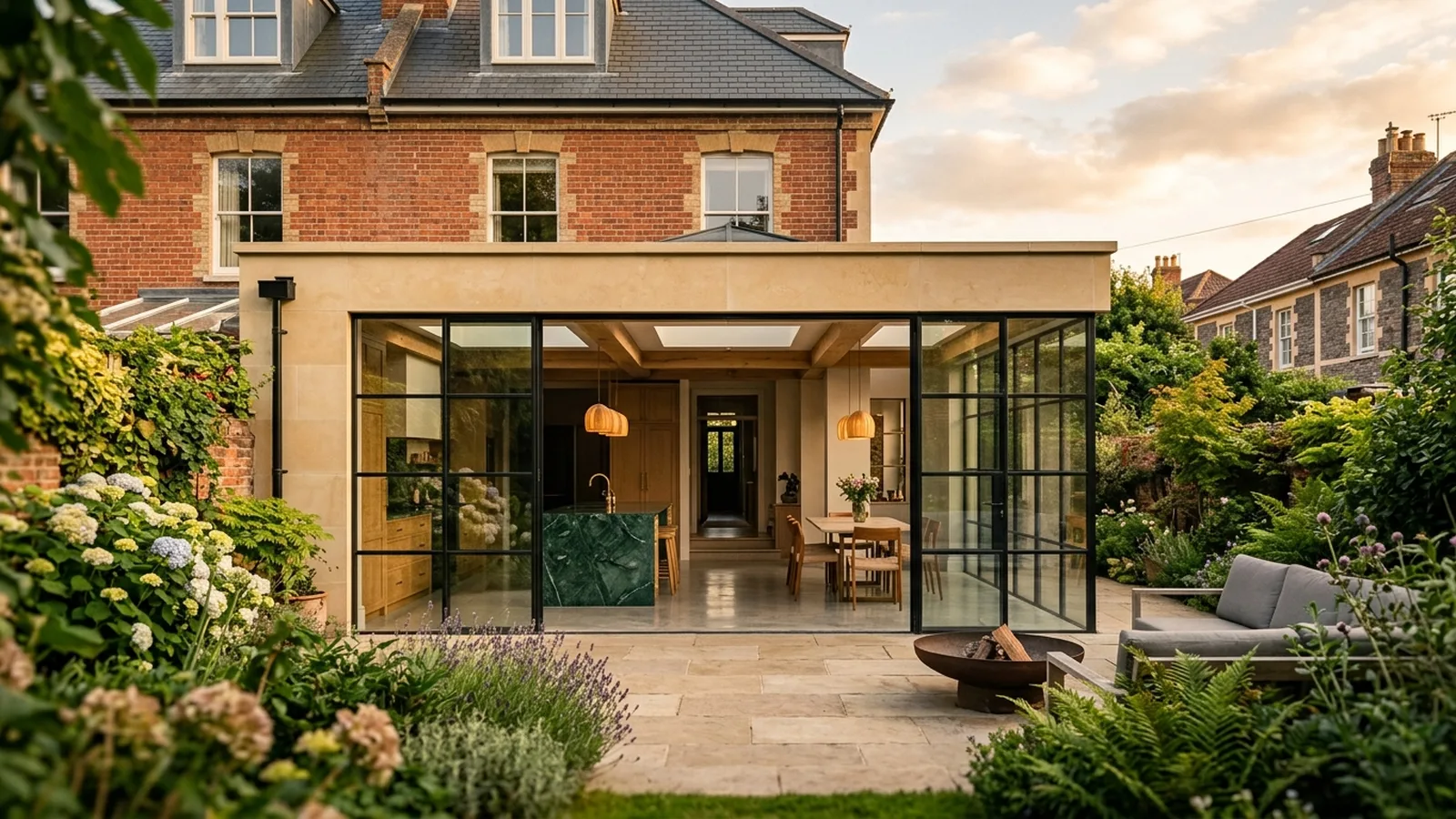
Design quality makes a real difference here. A successful extension is not just extra square metres; it should feel integrated, balanced and considered inside and out. That is often where design-and-build can help, because decisions about budget, planning, construction and finishes are joined up from the outset. A recent NOOR renovation in the area shows the value of a carefully handled approach to improving and enlarging a home: view the project.
Ask which option best supports the next 5 to 10 years A useful final test is to think beyond the immediate pressure. If you extend, will the house still suit you in five or ten years? If you move, are you confident the new home genuinely solves the issues, rather than simply swapping one set of compromises for another? For many households, the best answer comes from reviewing several options side by side: stay and reconfigure, extend modestly, extend more ambitiously, or move. Seeing those routes clearly often makes the decision feel much less daunting.
Whether you are leaning towards extending or relocating, good advice early on can save time, money and second-guessing later. If you would like to talk through your home, priorities and likely options in Bristol, we would be glad to help you request a consultation.
[ Talk to NOOR ]
Planning a project of your own? Request a free initial consultation and we will give you honest, informed advice on your home.
Request a Consultation